
The Uncut Field: Lughnasadh and Lammas August 1
The Turning of the Witch's Wheel
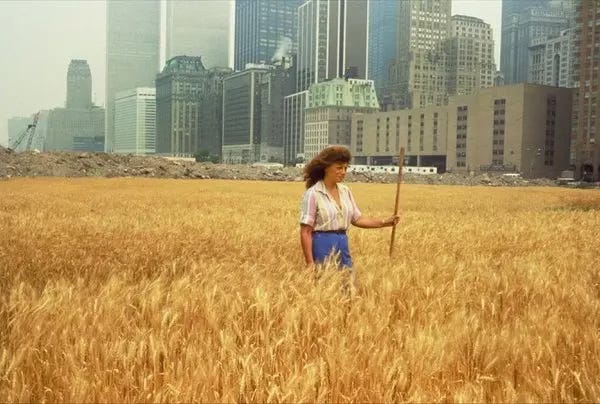
The Turning of the Wheel
On Saturday August 1 join me while I host a short lecture on the history of Lughnasadh/Lammas, followed by an intimate participatory ritual at 12:00 EST for paid subscribers. The zoom link and list of simple materials will sent at 11 EST.
The Witch's Wheel of the Year is the cycle of eight seasonal festivals solstices, equinoxes, and the midpoints between them that maps the turning year onto themes of birth, growth, harvest, and death. We live inside a calendar built for productivity, with no room in it for the possibility that the crop might still fail. The Wheel of the Year gives us permission to name uncertainty as its own season, Marking each point on the Wheel isn’t grounding and orientation.
Harvest. Risk. Labor. Three words associated with Lughnasadh, this is an elusive holiday it doesn’t announce itself the way the others on the Wheel do. It isn’t Samhain’s ancestors, isn’t the sexuality of Beltane, isn’t the fertility of Ostara. It is the first harvest holiday of the year.
Upgrade to a paid subscriber to my Substack ($8.88/mo) receive all bi-monthly witch sabbath talks and rituals, pop up events, an private articles on creativity, witchcraft, tarot, and more while supporting a space that lets magic, feminism, and art flourish. Thank you!
Know someone who might enjoy this? Please comment re-stack or share it, that supports the essay getting seen and read by more people. Thank you!
Essay Below The Uncut Field
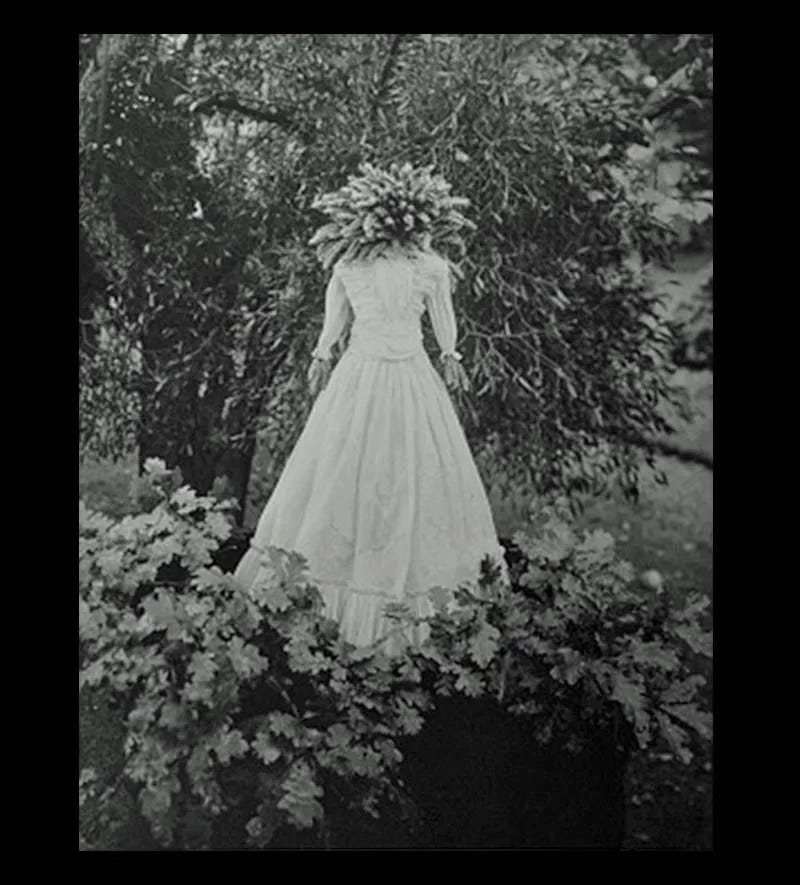
A little over a month ago, I wrote to you from inside the longest day of the year the piece where I told you my mother had died. I wrote it from the very peak of the light, and even standing inside all of that light, I was writing about loss. The witch’s wheel didn’t pause for that. It kept turning, the way it always does, and here we are one more spoke along: the first harvest.
I’m writing this in New York in the last days of July, no classes to prep yet, no semester grid telling me where I’m supposed to be. Just the studio, the art world quiet the way it goes quiet every August, and whatever I can make myself do in a day with no bell to mark the start or end of it. Many of us find that kind of open, unstructured time disorienting in the creative process and in the spiritual one alike. Without a bell telling you when to begin and when to stop, freedom can feel a lot like drift.
This is why I keep coming back to the Wheel of the Year. It isn’t decoration. It’s an anchor. A five-day workweek doesn’t know what to do with grief, or with waiting. The Wheel does. It gives you eight fixed points across the year and says: here is where you are, here is what this season has always asked of people. We’ve moved through it together across several turns now the returning light at Yule, Imbolc’s first stirrings, Ostara’s promise, Beltane’s fire, and then the longest day, the one that held my mother inside it. Now, a spoke further on: the first harvest in sight. If you observe quietly even in an uneven setting, the light has turned slightly. The fall is in sight.
And this holiday is a strange one to land on right now. It isn’t Samhain, with its ancestors at least allowed to be spoken of directly, or Beltane’s sexuality, or Ostara’s easy promise of rebirth. Lughnasadh hands you a field that isn’t finished yet, grain that’s been cut, or almost cut, and still at risk. It is a holiday of harvest, risk, and labor and, somewhere underneath all three, of gratitude, however uneasy that gratitude has to sit while the outcome is still unknown.
Lughnasadh (LOO-nah-sah) named for the Celtic god Lugh, master of poetry, healing, magic, warfare, competition is one of the four great Gaelic fire festivals, marking the grain harvest, the one everything else depends on. Unlike the solstice’s plenty of light, Lughnasadh is a threshold no one can be certain of yet. A storm, a blight, a single bad week could still take it all. This is the sleeper holiday of the Wheel.
The Dark History of the Grain
Lughnasadh dates to the Celtic Iron Age, associated with Óenach Tailteann the Tailteann Games, held at Teltown in County Meath. The games were founded by Lugh himself, specifically as a funeral rite in honor of his foster mother, Tailtiu which makes this, underneath the trading stalls and crowds, a mourning festival first. Real competitions were run in her name every year: footraces, wrestling, contests of strength, the way a modern memorial run might honor someone a community lost. No direct funerary rite for Tailtiu survives intact into the present the mourning purpose was the first thing to fall away once the gathering became fair and marketplace. What did survive, oddly, was the shape of the competition itself: the Irish Free State revived the Tailteann Games as a national sporting and cultural festival in 1924, 1928, and 1932, staged deliberately around August 1st, with athletes traveling in from the Irish diaspora across the world. That revival lost its funding and its momentum by the 1930s, but a small grassroots version returned again in 2025, held among the ruins of Kells Priory proof that even a stripped-down echo of Tailtiu’s games, sport without the explicit grief attached to it, keeps finding its way back onto the calendar. Alongside the athletics came trading, matchmaking, and the Tailltean marriages trial handfastings entered into for a year and a day, dissolved without shame if they didn’t work.
Tailtiu is the goddess almost no one outside Irish mythology has heard of, and she is the actual heart of this holiday. She was said to have died of exhaustion clearing the plains of Ireland for agriculture working herself to death so the land could be planted. Every loaf of bread baked from the first grain, every game played on the hilltop, is in some sense an offering back to a woman who gave her body so that food could exist at all. Even her name has had to be dug back out of obscurity: Tailtiu survives mainly in scholarly footnotes, place-name records, and the county that still carries her name Teltown which does very little to advertise the connection. She is not a goddess anyone hands you casually; you have to go looking for her.


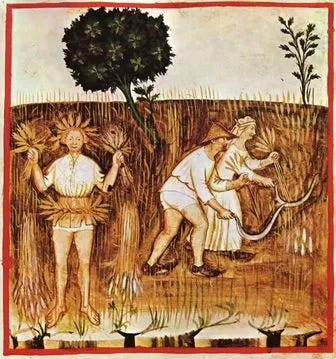
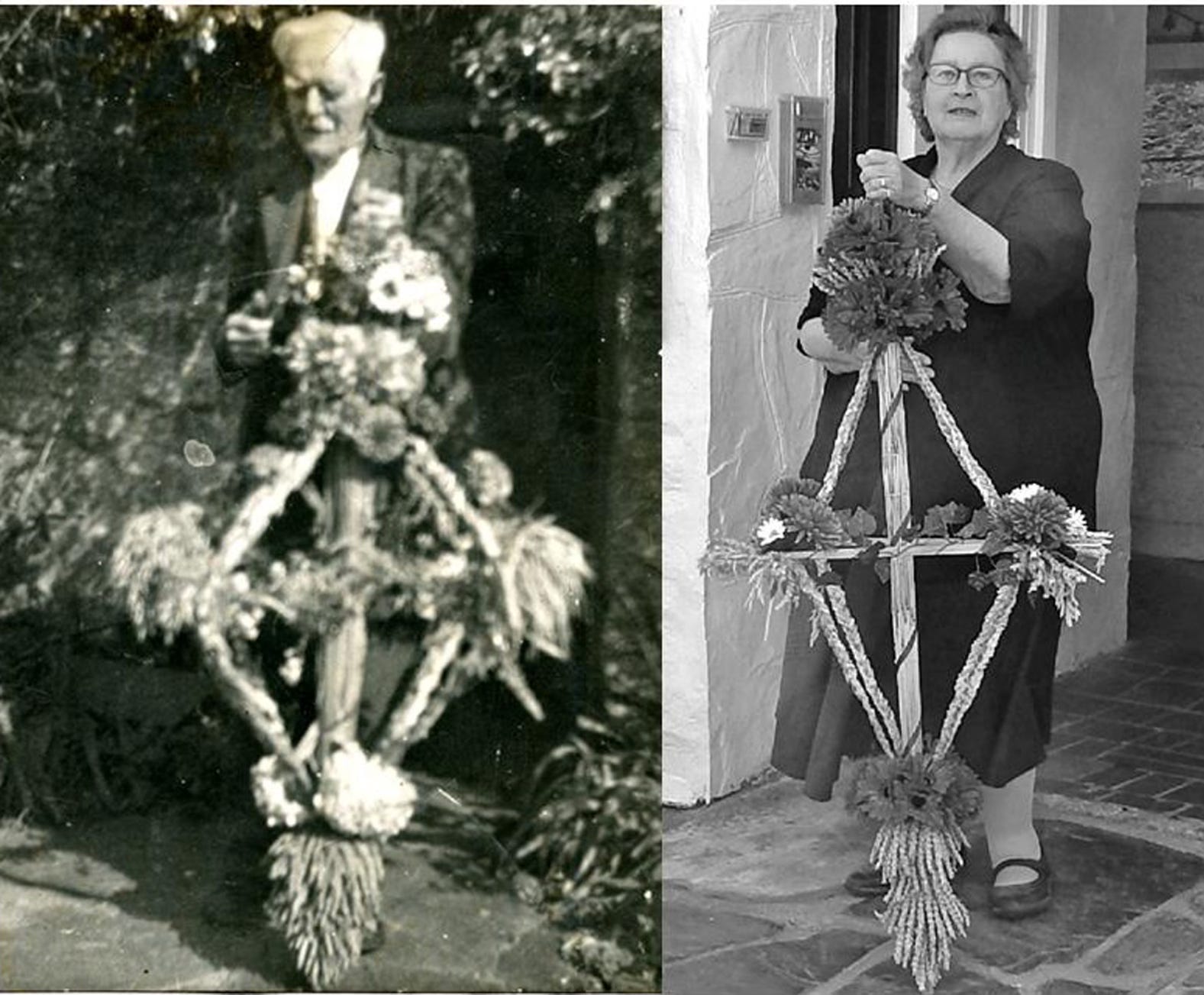
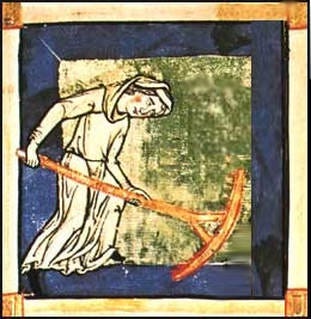
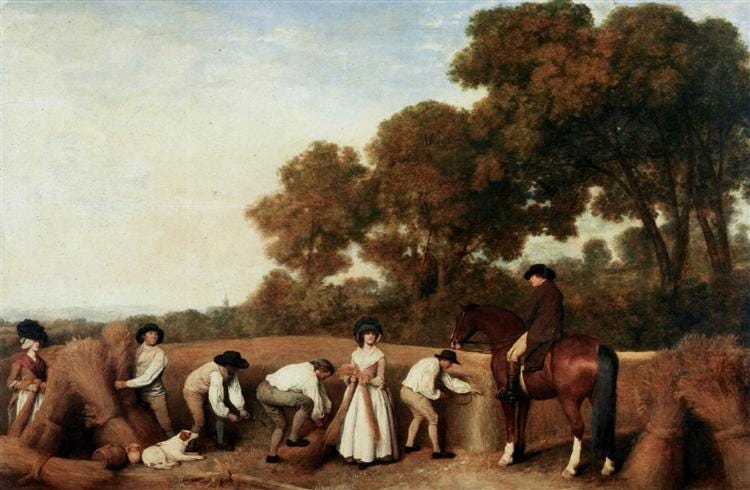
Out of that same instinct comes the strange and lasting tradition of the corn dolly. The belief was startlingly literal: a spirit lived inside the standing grain, retreating ahead of the reapers’ blades until it was cornered in the very last uncut stalks. In parts of Devon and Cornwall, the custom survives as “crying the neck” the harvester holds the final sheaf aloft and calls out three times, “I have ‘em, I have ‘em, I have ‘em,” and the field calls back, until the sheaf is named and bound in ribbon.
The custom had nearly died out with the arrival of the combine harvester, but it was deliberately revived in the 1920s by the Old Cornwall Society after they found that older farmworkers still remembered it, and versions of it are still performed today at village ceremonies like the ones at St. Columb and Madron proof that this is one Lughnasadh tradition that never fully disappeared, it just needed people willing to bring it back.
Elsewhere the last sheaf was plaited into a figure, named by region Corn Maiden in parts of England, but in Scotland, where the holiday is called Lùnastal, specifically the Cailleach: the Old Wife or Hag. Whoever finished harvest first made her, then passed her along to whoever was still working, until she landed with the last farmer done and nobody wanted to be the one left holding her, responsible for housing the Cailleach all winter. It’s impossible not to think of Tailtiu here: a woman’s body becoming the harvest, and then, every year after, a small woven body made from the harvest, kept through the dark, and finally returned to the ground so the cycle could start again.
Contemporary witches have continued this custom. Straw-weaving is having a real revival, and many covens still plait small dollies for the Lughnasadh altar — not to house a literal grain spirit anymore, but as a vessel for intention, plaited while naming what the year has already brought, kept through the dark months, and released at Imbolc when it’s time to plant again.


This is not a gentle myth. It is a sabbath about labor, and about the material body as the price of abundance. The harvest was never guaranteed. Some traditions also name Carman, a goddess of blight, whose defeat was itself commemorated at a Lughnasadh gathering a festival that remembers a woman who threatened the harvest and a woman who died bringing it into being, in the same season; death and life entwined.
Lammas: What the Church Called It
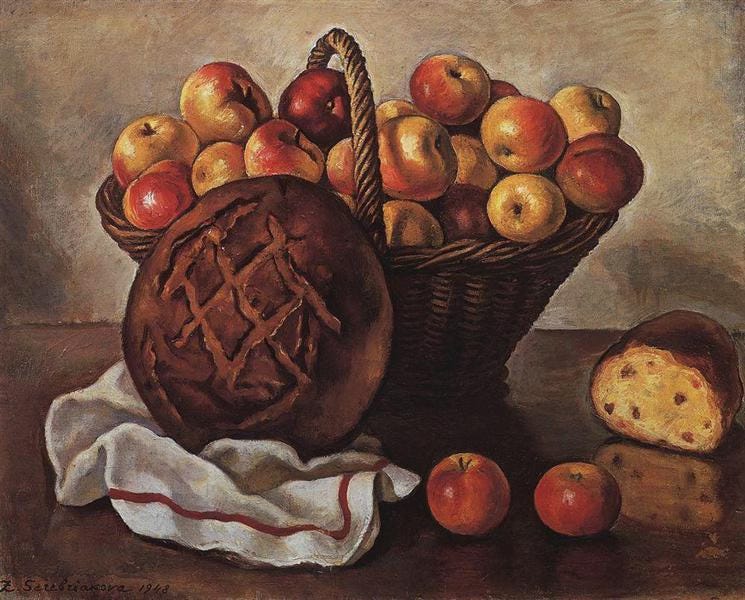
Instead of suppressing it, the Church absorbed it directly and created Lammas, from the Old English hlaf-mæsse, virtually “loaf mass.” On August 1st, a loaf baked from the first wheat was brought to church and blessed.
The blessing didn’t end at the altar. A book of Anglo-Saxon charms directs that the blessed loaf be broken into four pieces and crumbled into the four corners of the barn a protective charm over grain not yet fully brought in. This is why so many Catholic harvest customs feel like witchcraft because, underneath the vestments, they are. A related German tradition has the farmer bind the first three cut ears into a small cross, left in the churchyard or nailed to the door. I don’t think it’s incidental that this was almost certainly still women’s work the breaking, the carrying, the crumbling into corners no priest would bother with. This was quiet, domestic, load-bearing magic, the same register as the corn dolly.
That the Church didn’t feel the need to suppress this holiday the way it suppressed others tells you something. There was no female sexuality here to be afraid of, as there was at Beltane or even Ostara. Just a woman’s death, mythologized, then quietly absorbed.
Lammastide was also craft-fair season the medieval guilds decking themselves out in ribbons for the crowds, parading their wares through streets, the whole thing closer to a Renaissance fair than a somber rite. Its centerpiece was the Catherine wheel: a wagon wheel hauled to a hilltop, packed with tar, set alight, and sent rolling down the slope, the flaming disk standing in for the sun god’s decline as the year tips toward dark. The literal hilltop version of the custom has mostly gone quiet you won’t find many villages still tarring a wagon wheel and rolling it downhill but its descendant is still lit every year: the spinning firework that carries her name is a fixture of British and Maltese festival nights, and in Malta entire village feasts still climax with an enormous, elaborately built Catherine wheel set ablaze.
The gesture survives; it just changed shape, the way most of this holiday’s customs have. It’s named for St. Catherine of Alexandria, a saint the historical record barely holds onto she isn’t mentioned in any source before the 9th century, and most scholars now treat her as legend more than fact: a noblewoman said to have converted hundreds to Christianity before being sentenced to death on a spiked breaking wheel, which shattered rather than touch her, so she was beheaded instead. Her feast day is November 25th, nowhere near Lammas on the calendar it was Lammastide’s craft fairs and fire customs that pulled her in sideways, through the wheel of her martyrdom rather than through her actual feast.
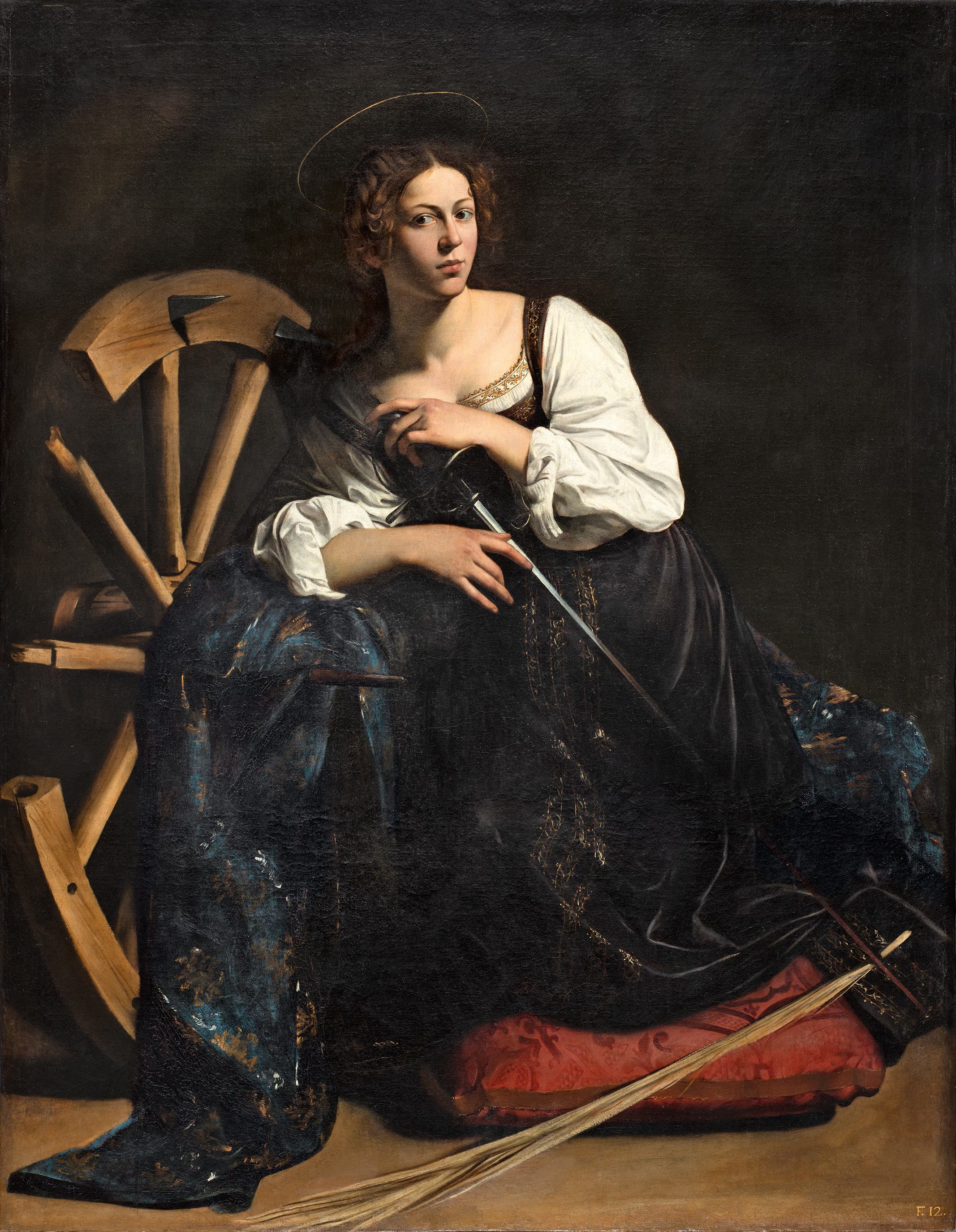
She is not even the only Catherine the Church has Catherine of Siena and Catherine of Bologna both have their own feast days and their own cults but it’s Catherine of Alexandria, the disputed one, whose wheel got folded into this holiday. Even the saint they attached to this holiday, they couldn’t fully keep hold of. Another woman the record can’t quite pin down, at the center of a festival about a woman the record barely kept at all.
Corn Rigs, John Barleycorn, and Other Ghosts
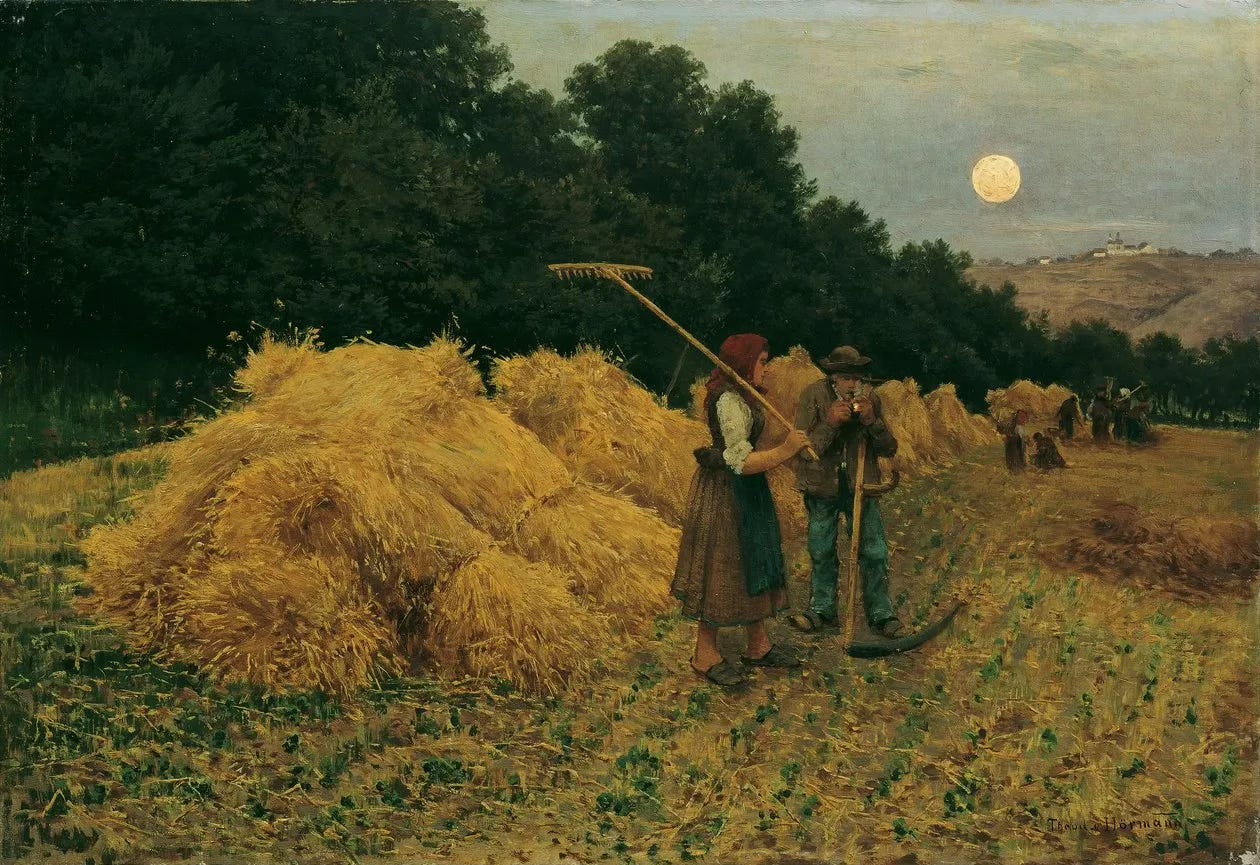
It was upon a Lammas night,
when corn rigs are bonie,
beneath the Moon’s unclouded light,
I held awhile to Annie: […]
Robert Burns wrote that in the 18th century Lammas remembered as a night people fell into each other in the barley rows, not only a harvest ledger. He also wrote a darker song about this season, “John Barleycorn”: three kings swear an oath that Barleycorn must die; he’s cut down, ground, and poured out as whisky, and still comes back up out of the ground every year. It’s the male version of exactly what I’ve been circling with Tailtiu a body given to the field and made to return. Barleycorn gets verses and a folk-hero swagger, while the goddess Tailtiu gets a footnote most people never read. Same wheel, very differently mourned.
The contemporary poem “The Lammas Hireling,” by Ian Duhig, pulls this season’s darker thread somewhere genuinely unsettling a farmer hires a young man around Lammas, the harvest comes in unnaturally well, and under a full moon he transforms into a hare and he realizes has been working alongside a witch. More unfolds, I won’t spoil it, but it belongs on any real Lughnasadh reading list worth seeking out directly rather than summarized here.
And there’s the myth modern practitioners reach for as Lammas’s cross-cultural twin, even though it’s Greek: Demeter and Persephone. A mother’s grief, not a hero’s sacrifice, creates the turning of the seasons in that story. I mark this Lughnasadh with my own mother a month gone, and I can’t read the Demeter myth anymore as symbol, at a remove. A mother’s grief making the ground go quiet before anything can grow again.
The Empress Tarot Card and the Grain
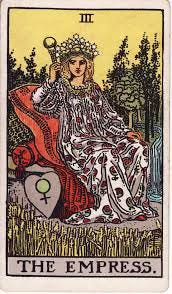
Pull the Empress from any Rider-Waite-Smith descended deck and look at what’s under her feet: wheat, grown up to her throne. Most readings stop at “fertility” and move on. I want to focus there instead.
The grain under her feet is the same grain Tailtiu died clearing land for. But look at the difference in posture. Tailtiu’s body became the harvest; she is consumed by the labor of making it possible. The Empress sits in hers almost fused to the landscape. She has claimed the field as her domain, and rules it from a throne grown out of the very grain that, in the older myth, cost a woman her life. This is the feminist reading hiding in the card most people flip past: abundance, claimed rather than extracted, is power.
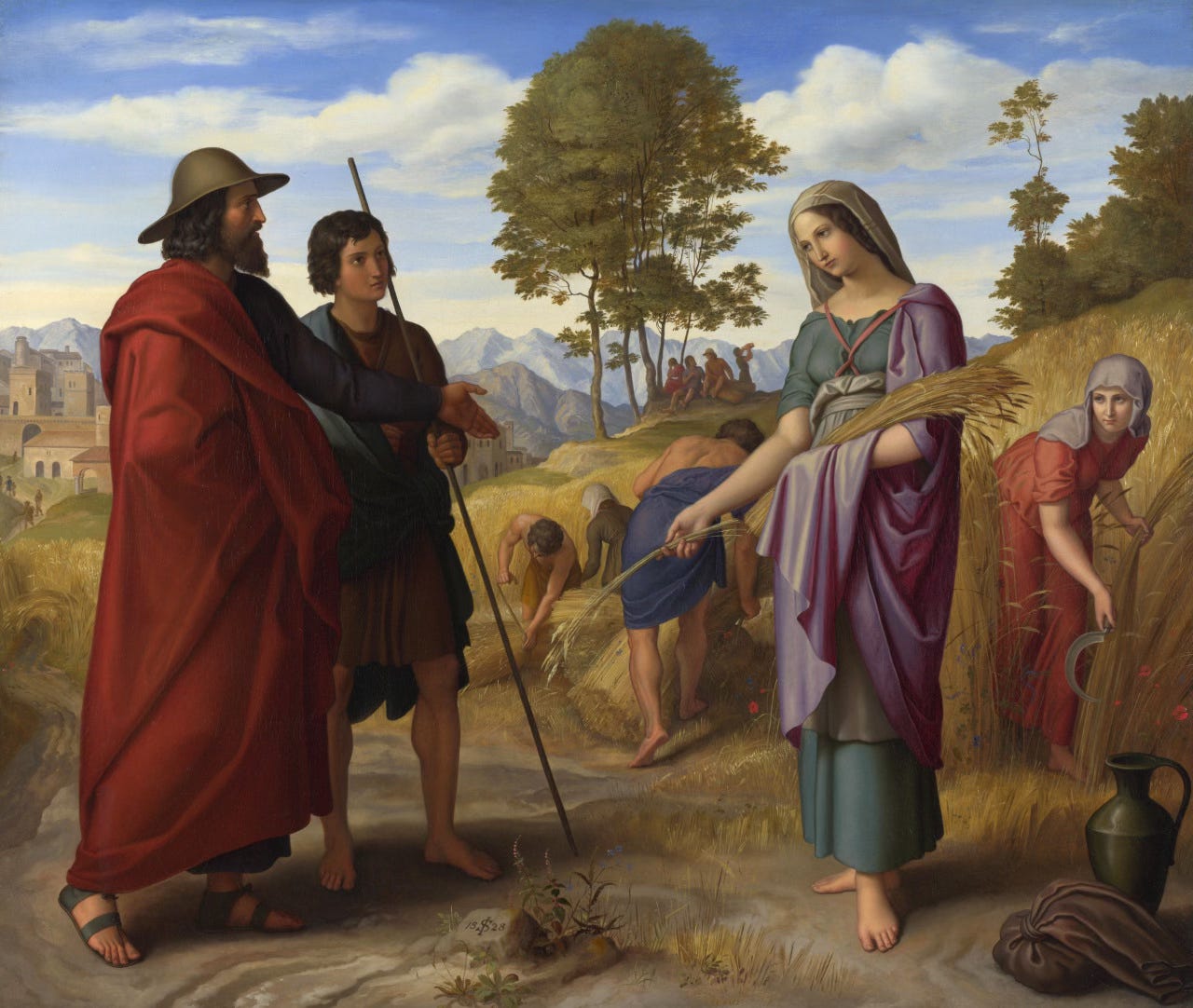
Material comes from mater — mother. The philosophical tradition running from Plato forward has ranked spirit over matter, mind over body, and coded the devalued half of every pair as feminine. The Empress, enthroned in her wheat field, is a direct refusal of that hierarchy. She is card number three, the card of creativity, following directly from the interior, receptive knowledge of the High Priestess before her, card number two. She is fully claimed in the material she sits in she wears it like a crown rather than carries it like a burden.
Wheat shows up constantly in needlepoint and samplers, too and in Victorian mourning jewelry, where grieving women braided actual human hair into wheat-sheaf shapes for rings and lockets. On gravestones from the same era, a sheaf of wheat marked a life that had reached its full season, gathered in at the right time. I keep thinking about this now because my mother is a month gone, and I am, without planning to, doing a version of the same thing: weaving grief into the material I actually have words, this Substack, the Wheel itself. The Empress’s field and the mourning ring aren’t as far apart as they look.
Lughnasadh gives you Tailtiu, exhausted into myth by labor. The tarot gives you the Empress, ruling the far side of that same field. Together they’re the whole story: the cost of the harvest, and what it looks like when a woman inherits it.
Sacred Risk, and the Body in the Field
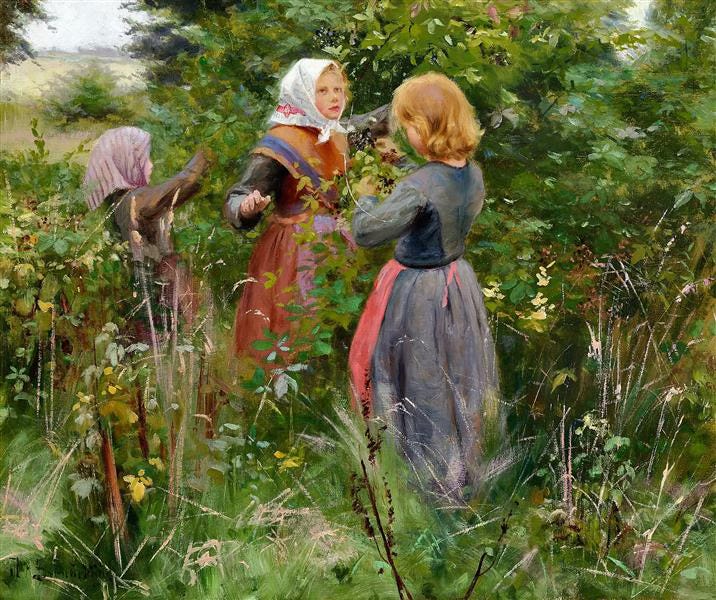
Fertility myths tend to promise that the body, given fully to creation, is sovereign and safe. Lughnasadh is the season that tests whether that promise holds. Tailtiu’s story isn’t a fertility rite \there’s no consent narrative, no sovereign choosing. Just a woman’s body converted directly into the possibility of food for others. Women’s labor creative, physical, reproductive has always been treated as a resource whose exhaustion is simply the cost of production. Lughnasadh doesn’t let you look away from that.
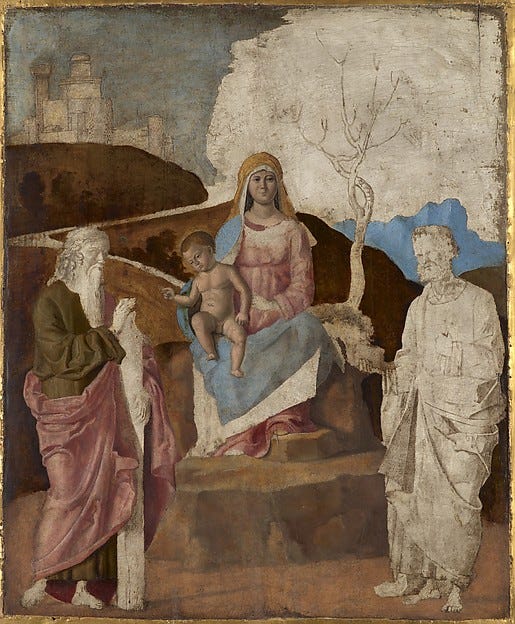
This connects directly to creative practice, and to you, reading this. Every one of us who makes something knows the Lughnasadh feeling: you have put in the labor, and now you don’t know yet if it will come in. This is, I’d argue, the most honest place on the entire Wheel. Other sabbats ask you to feel something fully in a single moment. Harvest asks something slower: to wait, to keep working without knowing the outcome, the way every artist does when they put unfinished work into the world. I think of the Met Breuer’s 2016 show “Unfinished: Thoughts Left Visible” staged, fittingly, inside the old Whitney building on Madison Avenue which hung Michelangelo sketches and half-finished Renaissance panels next to contemporary work, all of it left incomplete for reasons ranging from death to deliberate refusal. Standing in a room built for a museum that no longer lived there, looking at paintings their makers never got to finish, felt like standing inside Lughnasadh itself: the labor is visible, the outcome isn’t, and the work still counts.
Lughnasadh and Lammas Simple Rituals
Bake something. Bread if you can the oldest Lughnasadh practice there is.
Name what you planted. What did you commit to that hasn’t resolved yet?
Sit with the not-knowing. Let the ritual be about tolerating that gap without rushing to resolve it.
Make an offering to Tailtiu. A moment of real acknowledgment for uncredited labor yours, or those who came before you.
Do one piece of unfinished work in the open. Post the thing you’re not sure has “worked” yet.
A few smaller, stranger ones, if you want to go further: Braid a small dolly from any dried stalks you can find wheat, dried grass, even raffia and set it somewhere you’ll see it daily until Imbolc. Buy or pick the first fruit or vegetable of the season and leave a small piece of it outside your door before you eat the rest, the way older harvest customs always paid the ground back first. Write down the one thing you’re still waiting on, seal the paper, and don’t open it again until Samhain let the not-knowing have an actual container instead of just living in your head.
Dannielle Tegeder is an artist, witch, and professor based in New York. The Conjuror’s Studio publishes on witchcraft, tarot, feminism, and the sacred in everyday creative life. Paid subscribers receive access to live rituals and collective tarot readings..
You write, "Women’s labor...has always been treated as a resource whose exhaustion is simply the cost of production" - I am feeling that a lot these days, that our mental and physical labor is expected to be given freely. Struggling to try to escape that narrative but it's woven so deeply into the cloth that makes up the entire world.
Simple connections, before I read this wonderful essay, I felt compelled to make a batch of dough for fresh bread. Now I think I'll add a little extra loaf for my altar for tomorrow's gathering. I'm looking forward to sharing this ritual with you all.